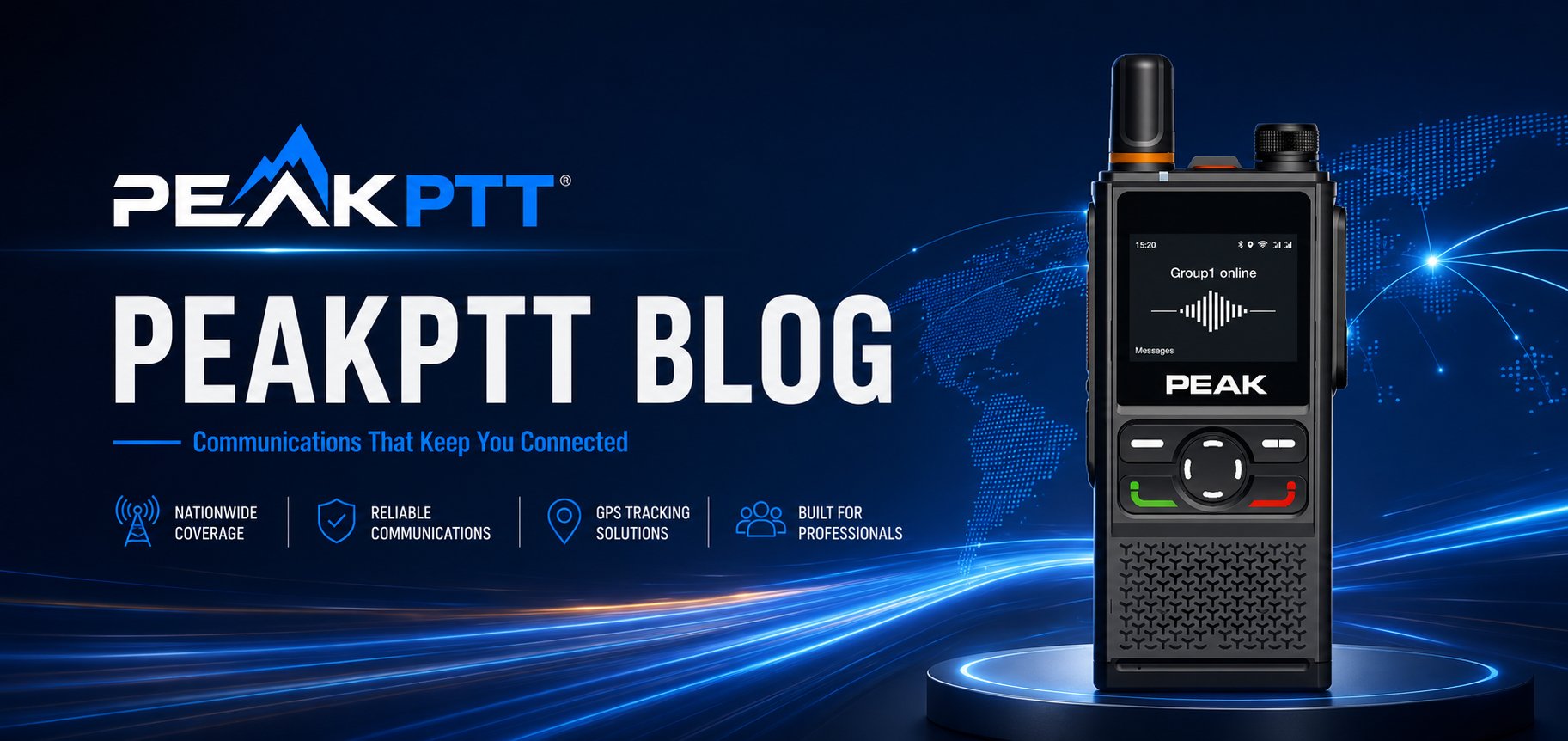

Quick answer: Push-to-talk over cellular (PoC) radios are two-way radios that communicate over nationwide 4G LTE networks instead of a local radio channel. For a business, that means one button reaches a crew across the yard or across the country, there is no FCC license, repeater, or tower on your side, and the flat $24.95 per radio per month includes GPS tracking, encrypted communication, recorded calls, and managed talk groups. This guide covers how it works, what it costs, and how to decide if it fits.
How push-to-talk over cellular actually works
A PoC radio looks and behaves like a classic walkie-talkie: press the button, wait for the ready tone, talk. Underneath, the voice travels over the same nationwide 4G LTE networks your phone uses, and on Wi-Fi-capable models, over any wireless network, so coverage is the carrier map plus your building’s Wi-Fi rather than the range of a repeater. Call setup takes about one second, and a talk group can carry up to 2,000 users, so an all-company announcement works the same at 5 radios or 500.
Because the radios ride the carriers’ licensed spectrum, your business files nothing with the FCC. There are no frequencies to coordinate, no license renewals, and no interference disputes with the shop across town.
What the service includes
- Nationwide talk groups organized around your operation: one per crew or region, supervisor groups across them, an all-call for everyone. Lineups change over the air at no charge.
- GPS tracking built in: every radio reports its position every 60 seconds with 90 days of history. No separate tracking hardware or subscription.
- Recorded calls with instant playback, which settle who-said-what disputes with a recording instead of an argument.
- Encrypted communication, so traffic is not readable off the air the way analog channels are.
- Dispatch when you want it: a PC console at $12 per seat per month adds the live map and full dispatch control, and a mobile app at $9.95 per month puts managers’ phones on the same talk groups.
What it costs, in plain arithmetic
Hardware runs $129 to $389 per radio depending on model, service is a flat $24.95 per radio per month with no contract, and activation is $19.95 once per device. Radios arrive pre-programmed with your talk groups. There is no infrastructure line item because there is no infrastructure on your side.
We published the full comparison against owning a traditional repeater system, with every external number cited: in the three-year model for a 10-radio fleet, PoC service totals about $10,472 against roughly $17,100 for traditional LMR ownership. The complete arithmetic, sources, and honest caveats are in our ROI report.
Choosing the hardware
Every PeakPTT model runs on the same service and shares the same talk groups, so fleets mix freely: the $129 PTT-284G as the fleet workhorse, the PTT-324G where noise and weather demand the loudest rugged handheld, the Android PTT-624G for supervisors who want the team map on the radio itself, and the vehicle-mounted PTT-M14G for trucks. The full lineup comparison puts every spec side by side.
Where PoC fits, and where it does not
PoC is built for teams that outgrow a single site: multi-building operations, fleets that drive, companies spanning cities or states, and seasonal operations that scale radios up and down month to month with no contract. If your operation is one fixed site with a paid-off repeater system that covers it, keep using it; an RoIP gateway can bridge that system to nationwide PTT so both fleets share traffic. The deeper comparison lives in our PTT over cellular vs two-way radios guide.
What running it day to day looks like
Radios ship pre-programmed, so day one is opening the box and pressing the button. Changes afterward, new groups, renamed radios, a reorganized fleet, happen over the air by calling support, which is 24/7 and U.S.-based. Hardware carries a lifetime warranty while on active service, and everything is backed by a 45-day money-back guarantee.
Frequently asked questions
Do PoC radios need cell phone plans?
No. The radio’s connectivity is part of the $24.95 monthly service. There is no carrier contract, SIM plan, or phone bill on your side.
What happens inside buildings with weak cell signal?
Wi-Fi-capable models run push-to-talk over the building’s wireless network, so warehouses and steel buildings are covered by your own internet where cellular thins out.
How fast can a business get started?
Radios arrive pre-programmed and working out of the box, typically shipping within about two business days. The one skill to teach: press, wait for the tone, talk.
Is there a contract?
No. Service is month to month, and the 45-day money-back guarantee covers the decision itself.