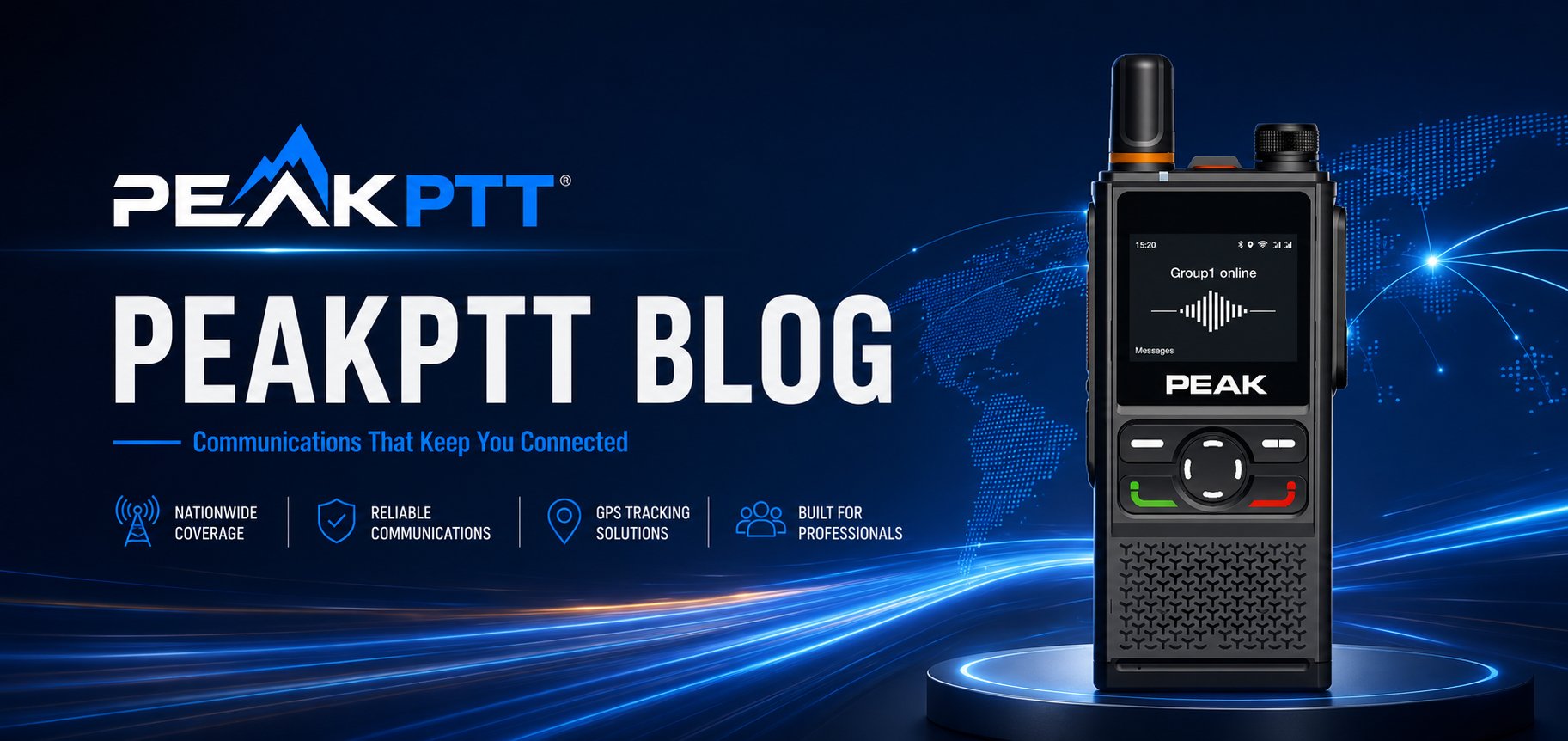

While it is important to adopt the latest communication technologies to improve businesses, keeping an eye on your competitors’ strengths can help you stay in the game for the long run.
Adopting the latest communication technologies, like push-to-talk two-way phones, may become an important factor when your competitors are already using them to improve the productivity of their employees.
Industries That Have Adopted PTT Two-Way Radios for Communication
PTT two-way radios have become the chosen communication tool for several industries, including:
- Construction and energy companies.
- Trucking, transportation, and towing companies.
- Agricultural and farming companies.
- Organizations offering essential services like the ambulance and firefighters.
- Hospitality, entertainment, and healthcare sectors.
- Public safety.
Why are your competitors using PTT two-way radios?
Many businesses are increasingly favoring PTT radios over traditional radio systems and cellphones as their primary communication tools.
The reasons include:
Nationwide coverage:
Unlike traditional radios, modern PTT radios, like PeakPTT two-way radios, use push-to-talk over cellular (POC) radio devices that connect through 4G LTE/WIFI technology to provide nationwide coverage to their users.
Instant, reliable communication:
PTT radios offer instant, reliable communication at the push of a button, allowing employees to connect faster, improving their productivity and morale. They also offer reliable communication in remote areas and those with poor network transmission.
The radios have a noise-cancelling feature that allows users to communicate even in a loud, outside environment.
Durability:
Unlike cellphones, the PTT radios come with a durable exterior that can withstand regular exposure to dust, moisture, dirt, and other challenging environmental conditions.PEAKPTT radios offer models like the PTT 624G LTE Radio that allow users to enjoy better communication for a longer period.
Advanced features:
PTT radio systems have advanced features like GPS tracking, instant voice communication, real-time translation, and multimedia sharing that offer improved, seamless communication.
Security features:
PTT radios have advanced security features, such as one-button push panic alarms, man down, and lone worker, which trigger an alarm allowing faster responses in case of worker injuries and other emergencies.
Cost effectiveness:
Unlike expensive cellphones and traditional radios with costly infrastructures, PTT radios are cost-effective radio devices that have an easier user interface and can be used right out of the box.
Hands-free communication:
PTT radios, like PeakPTT solutions, offer hands-free accessories, like the PTT 84-G Surveillance Headset, which allows users to better communicate without disrupting work.
Multiple channels:
PTT radios have multiple channels that allow users to use a dedicated channel to communicate simultaneously with several users.
Many industries
The Competitive Landscape of 2026: Why Communication is King
In the rapidly evolving business environment of 2026, operational efficiency is the ultimate differentiator. The margins between market leaders and those struggling to keep pace often come down to the speed and reliability of internal communication. While traditional tools served their purpose, the current decade demands instant, secure, and data-rich interactions. Your competition isn’t just seeking communication; they are seeking integration, safety, and scalability—all delivered through modern Push-to-Talk (PTT) systems.
The shift from legacy two-way radio infrastructure to Push-to-Talk over Cellular (PoC) represents one of the most significant digital transformations in enterprise operations today. This isn’t just an upgrade; it’s a paradigm shift that leverages ubiquitous cellular and Wi-Fi networks, ensuring communication isn’t constrained by localized radio repeaters. By adopting technologies like PeakPTT, savvy businesses are effectively turning their entire operational footprint into one seamless, unified communication network.
PTT and the Dawn of 5G Integration: A 2026 Imperative
While the existing infrastructure relies heavily on 4G LTE/WIFI technology, the year 2026 marks the widespread integration of 5G capabilities into PTT devices and networks. This transition dramatically enhances the core benefits of PTT.
The immediate impact of 5G on PTT is twofold: enhanced speed and ultra-low latency. The near-instantaneous connection PTT is known for becomes even faster, virtually eliminating lag time between pushing the button and broadcasting a voice command. For sectors like emergency response and logistics, where milliseconds count, this upgrade is indispensable.
Furthermore, 5G’s massive data capacity supports more robust multimedia sharing. While 4G allowed for basic image and video exchange, 5G enables high-definition, real-time video streaming from field teams back to command centers, offering unprecedented situational awareness.
Imagine a construction manager receiving live video feed from a crane operator or a security team instantly sharing high-resolution surveillance images—this is the reality your competitors are capitalizing on in 2026.
Deep Dive into PTT Adoption Across Key Industries in 2026
The diverse range of industries that have embraced PTT two-way radios showcases its versatility and essential nature in modern operations. In 2026, the application of these tools has become specialized and deeply integrated into industry-specific workflows.
- Construction and Energy: The construction site of 2026 is a complex ecosystem of human and robotic assets. PTT radios serve as the central nervous system. Beyond instant voice communication, GPS tracking is now used for precise asset location, ensuring materials and heavy machinery are exactly where they need to be, minimizing costly downtime. Energy companies, particularly those managing widespread pipelines or remote renewable energy farms, rely on the nationwide coverage of PoC devices to maintain contact with field technicians operating far beyond traditional radio range. The PTT 624G LTE Radio, known for its durability, is often integrated with safety sensors to monitor hazardous environments and ensure regulatory compliance.
- Trucking, Transportation, and Towing: In logistics, time is money. PTT provides dispatchers with an always-on channel to drivers. The integrated GPS tracking has evolved into sophisticated fleet management. Dispatchers can set up geofences, automatically alerting both the driver and central office when a vehicle enters or leaves a specific zone, optimizing delivery schedules and verifying arrival times. The hands-free communication capability, often utilizing accessories like the PTT 84-G Surveillance Headset, is crucial for regulatory compliance and driver safety. Furthermore, PTT devices are increasingly integrating with electronic logging devices (ELDs) to provide a unified platform for communication and regulatory record-keeping.
- Agricultural and Farming Companies: Modern large-scale agriculture is high-tech, involving precision planting and harvesting across vast territories. PTT’s reliable communication in remote areas, where traditional cell service might be spotty, is invaluable for coordinating equipment movements and reacting instantly to weather changes or mechanical failures. The durability of the radios, resisting exposure to dust and moisture from field operations, provides a significant advantage over consumer-grade cellphones.
- Essential Services (Ambulance and Firefighters): For essential services, communication interoperability is a matter of life and death. PTT systems are moving toward seamless integration with other emergency communication protocols. Features like real-time translation are critical when first responders must quickly gather information from individuals who speak different languages. Instant voice communication allows for rapid deployment and coordination between multiple teams on the scene. The noise-cancelling feature is crucial in high-decibel environments, such as a fireground or busy accident scene, ensuring commands are heard clearly.
- Hospitality, Entertainment, and Healthcare Sectors: These sectors rely heavily on discreet and rapid internal coordination. In a large hotel or hospital, PTT devices allow departments—from housekeeping to maintenance to security—to communicate instantly across multiple channels. In healthcare, quick, secure group communication is vital for rapid patient transfer or responding to critical alerts. The security features, such as the one-button panic alarm, provide staff with a reliable way to call for help discreetly in high-stress situations.
- Public Safety and Inter-Agency Cooperation: Public safety agencies are using PoC PTT to bridge communication gaps that plagued older radio systems. In 2026, agencies frequently work together, and PTT provides the necessary multiple channels to establish dedicated, secure communication groups between police, fire, and municipal services during large-scale events or emergencies. The “lone worker” and “man down” features have become essential tools for officer safety, automatically monitoring a responder’s status and triggering an alert if unusual inactivity is detected.
Maximizing the Advanced Features of PTT in 2026
The advanced features of modern PTT radio systems are what truly distinguish them from predecessors and common consumer devices. Leveraging these capabilities is how competitors gain their operational edge.
- Dynamic GPS and Telematics Integration
Beyond simple location tracking, 2026 PTT solutions offer dynamic telematics. This includes detailed route histories, speed monitoring, and idle time reports. This data is used not just for security, but for optimizing business processes and reducing fuel consumption. The level of detail allows managers to audit operational efficiency, providing concrete data points to inform training and resource allocation. For companies managing large fleets, this integrated telematics suite within the communication device is a powerful tool for compliance and cost management.
- Next-Generation Security and Safety Features
The security features in modern PTT devices go far beyond simple panic buttons.
Man Down and Lone Worker Monitoring:
These features utilize motion and tilt sensors to automatically detect if a user has fallen or remained motionless for an unusual length of time. When triggered, the device automatically sends an alert, including GPS coordinates, to a supervisor or dispatch center, significantly reducing response time in critical injury scenarios.
Geofencing Alerts: This safety measure allows businesses to define virtual boundaries. If a worker or vehicle equipped with a PTT device moves outside a pre-determined safe or authorized area, an alert is immediately sent. This is invaluable for securing assets and ensuring personnel remain in designated operational zones.
Encrypted Communication: Data security is paramount in 2026. PTT over Cellular inherently offers greater security than traditional analog radios. Many modern PTT providers utilize advanced encryption protocols to ensure that sensitive business or public safety communications remain private and secure from unauthorized interception.
- Real-Time Translation and Global Connectivity
With global supply chains and increasingly diverse workforces, the real-time translation feature is transitioning from a novelty to a necessity. Modern PTT systems incorporate advanced AI algorithms that can instantly translate voice communications between team members speaking different languages. This capability dissolves language barriers in international operations and multicultural work environments, drastically improving team coherence and reducing communication errors. The nationwide coverage supported by PoC means these translation capabilities are available across vast geographical areas.
- Cost-Effectiveness and Scalability
While cellphones represent a significant capital expense and often require costly individual service contracts, PTT systems offer superior cost effectiveness.
Low Infrastructure Costs: PTT systems use existing 4G LTE/WIFI networks, eliminating the need for companies to invest heavily in and maintain their own private radio repeaters and infrastructure. This significantly lowers the barrier to entry and ongoing maintenance expenses compared to traditional radio systems.
Predictable Subscription Models: PoC devices operate on predictable, scalable subscription plans. Companies pay a flat monthly fee per device, which includes nationwide coverage and access to all advanced features. This model simplifies budgeting and allows businesses to scale their communication capabilities up or down instantly based on project needs.
Purpose-Built Durability: The durability of devices like the PTT 624G LTE Radio means fewer device replacements compared to fragile consumer cellphones. This longevity provides a much lower total cost of ownership (TCO) in rugged environments. PTT devices are designed for extended battery life and exposure to challenging conditions, ensuring minimal operational downtime.
- Enhanced Usability and Workflow Integration
The user interface of PTT radios is designed for simplicity and speed. Unlike a smartphone that requires unlocking, navigating menus, and dialing, the PTT device allows for instant communication with a single, dedicated button push. This “out of the box” usability means minimal training is required, enabling faster deployment and quicker productivity gains.
The hands-free accessories, such as the PTT 84-G Surveillance Headset, further enhance usability by allowing personnel to maintain full focus on their tasks while communicating. This is critical in safety-sensitive roles, like operating machinery or guiding traffic.
- Future-Proofing Your Communication Strategy
The decision to adopt PTT technology today is a strategic move to future-proof your business. As 5G networks continue to expand and develop, PTT platforms are poised to seamlessly integrate new technologies, such as advanced IoT sensors and augmented reality tools, into the existing communication channels. Your competitors are setting themselves up to take advantage of these future innovations without requiring a complete overhaul of their communication systems. By choosing a scalable, software-driven PoC solution, they are investing in a flexible platform that can adapt to the communication needs of tomorrow.
The question is no longer if PTT radios are superior, but how quickly your competitors are realizing the efficiency gains from utilizing this communication platform. Don’t let outdated communication tools be the weak link in your 2026 operations.
PeakPTT serves a wide range of industries, and your competitors may be realizing efficiency gains from utilizing push-to-talk two-way radios. Don’t be left behind. Contact us at 855-600-6161 or complete our online inquiry form to learn more about our products and services.